
One More Time
A Reminder to Myself

Every few months I find it useful to remind readers, listeners, and, especially, myself of the genesis and underlying premise of Healing America’s Narratives as it manifested in the 2022 book, in this ongoing newsletter/podcast, and in the evolving curriculum I’ve been offering since the Spring 2024 semester. So today, we’ll share:
The necessary reminder alluded to above.
Updates on the National Pilgrimage, which begins next week on June 9, and the National Assembly that will take place online on July 6 & 7.
The June 3 excerpt from the forthcoming All of Us: A Pro-Democracy Book of Days for America.
What This Is
Quite a few historians, political scientists, journalists, legal scholars and attorneys, sociologists, spiritual leaders, scientists, and psychologists whom I read and/or listen to are offering us the benefit of the knowledge and wisdom of their respective domains regarding our democratic crises in America and the larger metacrisis within which it’s occurring. Each of these domains is essential and no one of them alone is sufficient to recognize, understand, and address the mess we face.
Healing America’s Narratives takes a multidisciplinary look at what’s unfolding and disintegrating. It offers an integrated perspective that, while not claiming to be a ‘last word’, holds a more inclusive, balanced, and complex view than any one of the individual disciplines can—and at the same time relies 100% on these disciplines and their practitioners.
So here’s a brief, current skeletal summary of the work:
Respect for the dignity of every human being, every sentient being, and the planet itself is a foundational prerequisite for democracy.
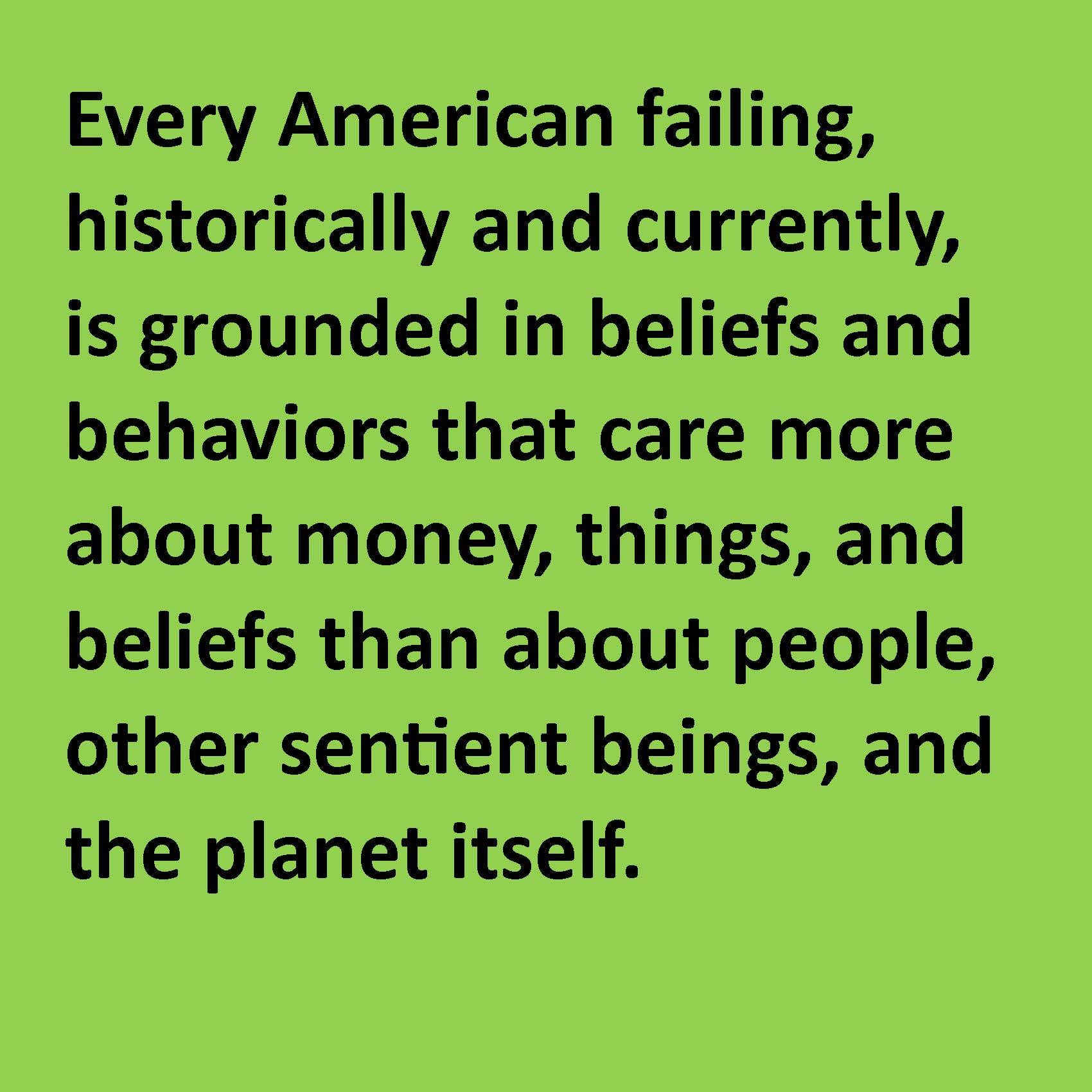
The foundational flaw in America’s 250-year democratic experiment is that its leadership perpetuates an infrastructure in which money and things are more important than humans, other life forms, and the planet itself.
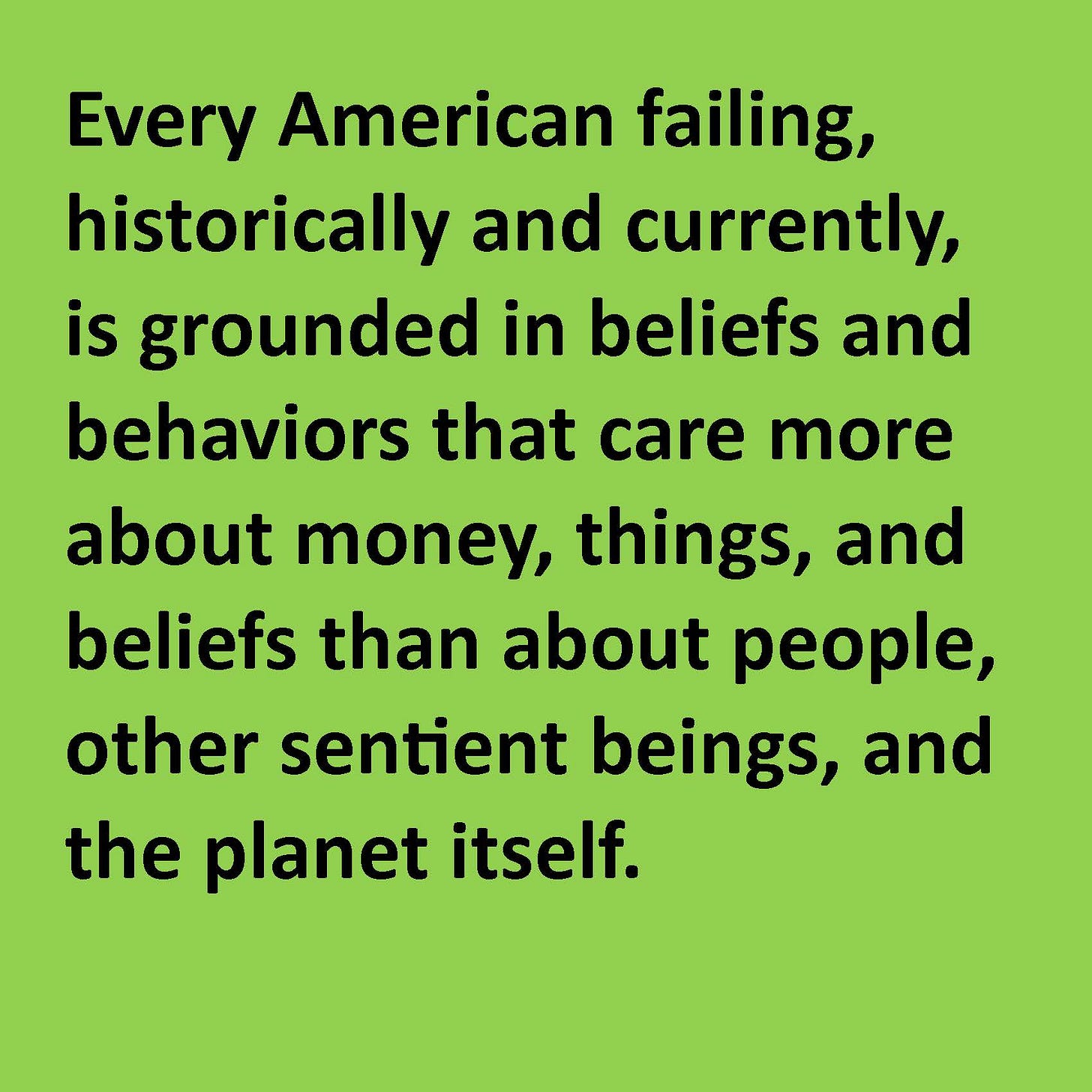
Evidence of this flaw is abundant, and easily seen in the foundational subjugations of women, Indigenous Peoples, and Africans, and the subsequent and current subjugations of many others, and of the planet itself.
The mistaken acceptability of this flaw and these subjugations has been passed down generationally through cultural givens—the worldview provided to children by their families, communities, religions, and other influences.
Much, if not all, of the details of these cultural givens and the subjugations they endorse are denied and repressed—held in shadow, in the unconscious—and projected onto others by tens of millions of humans.
Masculine and feminine energies or spirit can manifest in healthy or unhealthy ways.
Me-centric (only I matter), us-centric (only our group(s) matter), all-of-us-centric (all humans matter), and all-that-is-centric (everything matters) worldviews can manifest in healthy or unhealthy ways.
The collective shadow of the United States is characterized by an unhealthy manifestation of us-centric masculine energy in a virtual absence of the healthy feminine.
This unhealthy manifestation of us-centric masculine energy emerges from and perpetuates a culture and a society that is patriarchal, hierarchal, binary, and for many, Christian—men over women, straight over gay, white over black, rich over poor, Christian over non-Christian.
Within the shadow of this culture and society love is conditional, truth is bastardized, and freedom is limited to freedom from barriers and ignores freedom to be fully human.
The collective shadow keeps much of the nation stuck in myths of exceptionalism, individualism, and isolationism that hold the Constitution as sacred scripture rather than the body of experimental law that was in many ways extraordinary when it was written in the 18th century.
The collective shadow carries a nonrational fear of the words social, socialism, and socialized, especially when it comes to health care or helping those in need, unless those in need are corporations.
The Constitution is characterized by counter-majoritarian compromises such as the Senate and the Electoral College, by an amendment process that does not work in the polarization of the 21st century, by lifelong appointments of judges, and by the myth that the judiciary would be nonpartisan.
The nation’s history is characterized by the “dual and dueling” energies of those who want all citizens to vote and those who do not.
The relationships among the Christian Right, Project 2025, and Donald Trump make perfect sense in the context of the bullets that precede this one.
For those who focus only on the damage being done during the Trump years (which does warrant every human American’s attention), the issues faced in pre-2016 America, and those that will be faced in post-2028 America (and elsewhere) are enormous. They have been either ignored or exacerbated by Trump, but he did not create them. Some of them, in fact, created him.
Tens of millions of Americans live with varieties of individual, complex, collective, and intergenerational trauma.
Virtually all of this, maybe all of this results from mistaken identities and unhealthy habits of mind—who we think we are, how and what we think and feel, what we believe, and what we do.
Questions and statements like Who am I? How do I choose to be? Everything is a story. What am I missing? Who are my people? What’s my impact/what impacts me? and How am I in relationship with all of this and Life? can help us on our way.
That’s enough for now.
National Pilgrimage & National Assembly
Our May 20 post provided an introduction to the National Pilgrimage. If you’re interested and haven’t acted yet, note that the pilgrimage begins next Tuesday, June 9 in upstate New York.
Today, we’ll spend a bit of time with the National Assembly, which, again, will take place online on July 6 & 7. During the assembly, the following will take place. This information is lifted directly from the website:
All adults (over the age of 18) can take part in structured, facilitated rounds of conversation about the questions that matter most:
What do we value as a people?
What would it take for this nation to be a great place to be a parent, a kid, and an elder?
What do we owe to future generations?
These aren’t rhetorical questions. They are the inputs to a real non-partisan dialogue process, through a novel consensus-building platform, Synanim.
Participants from across the country — different ages, backgrounds, beliefs, and zip codes — will engage in multiple online rounds of dialogue, with each round building on the last.
The National Assembly is democracy in action. It is not an endgame, but a starting point. It is an opportunity to be in intentional community with others for the sake of a democratic America.
Here’s your preview from All of Us: A Pro-Democracy Book of Days for America. It is one of several that address skillful means in conversation.
Preconceptions & Assumptions.2 – June 3
“Of course, some preconceptions and assumptions can be helpful. Choosing to assume that many motor vehicle drivers are somewhat distracted can keep us safe. Choosing to assume that the walkway and road may be icy after an evening of freezing drizzle can be useful.”
- from Enough with the Talking Points
“Choosing to assume” are essential words above. We don’t know which drivers are distracted, but choosing to recognize that some, including ourselves, may be, allows us to be more prepared and less reactive—sparing both us and other drivers from us when someone is careless, and wildly grateful when someone is attentive or courteous. We don’t know which stretch of pavement is icy, but recognizing the probability of icy patches leads us to walk or drive with more care. An intentional choice to assume, while the assumption may or may not be inaccurate, is easier to eliminate or embrace than is an assumption that chooses us.
Bring to mind an issue about which you have strong feelings. Assess whether your feelings are more or less appropriate. If they’re not, do some shadow work (January 27-29). Check to see if you have a Sequoia or speck in your eye. Then explore what assumptions and preconceptions you have (or that have you) about anyone who might disagree with you on the issue.
Now have the difficult conversation, preferably with someone of good faith, and notice whether your assumptions and preconceptions hold up. You’re beginning to practice skillful means in conversation. You want to do more good than harm.
_____
Marra, Enough with the Talking Points, 21.
We’ll return to music for our sign-off today. Here’s John Gorka reminding us that there’s goodness in the world, with his song, “Particle & Wave”.